반응형
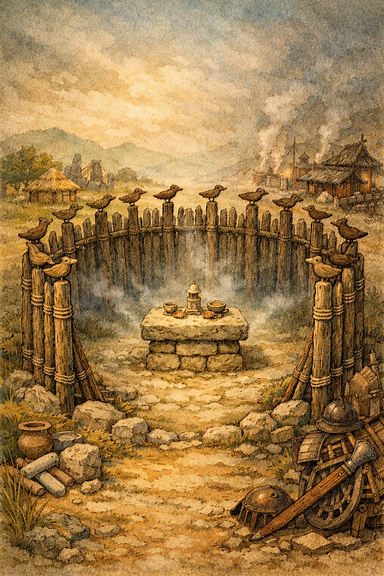
Sodo (蘇塗): The Paradox of a Closed Sanctuary
Written by Yeyeon Jeong Seung-yeon
It is profoundly disheartening to witness how long Gwangju intends to remain confined within the boundaries of a forbidden land, akin to the ancient sanctuary of Sodo (蘇塗). [1]
Gwangju was undeniably the vital spark of Korean democracy. In May 1980, it stood as a city where ordinary citizens shed their blood to defend human liberty against brutal state violence. [1, 2]
Today, however, the democratic spirit of Gwangju faces rigorous critique for being trapped within the sacrosanct confines of Mangwol-dong—remaining stagnant as a mere space of selective memory that does little more than endlessly repeat the name of "Chun Doo-hwan". [1]
This phenomenon chillingly mirrors the historical paradox of the ancient Sodo (蘇塗). Sodo originally emerged as a sacred sanctuary of freedom where political power could not reach, yet over time, it deteriorated into an isolated, closed space of self-containment and control. [1, 2]
If the spirit of Gwangju is to truly resonate and align itself with global democratization movements, it must fundamentally raise its voice for the essential freedom of the citizens of Pyongyang as well. When we assess North Korean human rights through the lens of democracy, it becomes glaringly evident why the Gwangju spirit must transcend a localized, historical memory. North Korea persists as one of the most closed, authoritarian regimes globally, where the basic liberty, political participation, and fundamental human rights of its people are severely suppressed. Therefore, linking North Korean human rights to the spirit of democracy is not a partisan political slogan; it is the natural expansion of a universal human value. [1, 2, 3, 4]
The democratic legacy of Gwangju is not the exclusive property of a single region, nor is it a stagnant monument. It is a spirit of active solidarity for anyone fighting for liberty and human rights anywhere across the globe. The struggle of Gwangju is inextricably linked to the longing for freedom in Pyongyang amidst the reality of national division; it intersects with the Tibetan community whose religious and cultural liberties are suppressed; it mirrors the civil resistance against military dictatorship in Myanmar; it aligns with the human rights crisis of the Uyghurs; it reflects the civil defiance and demands for liberty in Hong Kong; and it echoes Taiwan's arduous defense of democracy under relentless external pressure. [1, 2]
If it merely repeats past sacrifices while remaining barricaded inside the sanctuary of Mangwol-dong, Gwangju faces the immediate peril of becoming a closed, archaic space—just like Sodo. Instead of perpetually invoking the ghost of Chun Doo-hwan, Gwangju's spirit truly comes alive when it responds dynamically to the cries of all suppressed citizens across the world. Democratic ideals must never be held hostage by the memory of specific historical figures; they must expand into a collective voice for every oppressed human being. [1, 2, 3]
Gwangju must boldly throw open the gates of its self-imposed Sodo, look beyond Mangwol-dong, and step out onto the global stage. The spirit of democracy can never be a localized affair; it must remain a universal anthem of human liberty and unyielding solidarity. [1, 2]
The Historical Meaning of Sodo: A Personal Interpretation
From a historical standpoint, Sodo represented a sacred space in chieftain societies prior to the rise of walled town-states, where the Cheongun (heavenly priest) performed sacred duties. Possessing the gravity of a holy temple, it functioned as the core spiritual center of that society. The priest ruled over agricultural rituals and religious ceremonies independently from the secular political ruler. [1, 2, 3]
Because it was deemed so inviolable that outside political authorities could not enter to seize fugitives, it naturally evolved into a religious sanctuary completely cut off from the shifting political center. Ancient records even note that because fugitives who entered were never returned, the area inadvertently encouraged lawlessness. [1]
My personal interpretation is that Sodo was a distinct byproduct of the Bronze Age—a desperate, reactionary place of refuge used to resist the rising culture of the newly emerging Iron Age. When a sacred memory or space cuts itself off from the evolving world to protect its internal authority, it inevitably faces the tragic paradox of isolation and obsolescence. Gwangju must shed the skin of this closed sanctuary and choose the path of open, universal solidarity. [1, 2, 3]
— Written by Ye yearn Cheong Seung-yearn
🛣️ Journey of Reflection.
- 🔗 [A Society Where a Tank Cannot Be Called a Tank is Not a Healthy Democracy] (Link)
- 🔗 [Lifting the Veil of Symbols to the Ultimate Destination: Meditating on the Name and Essence on Buddha's Birthday] (Link)
- 🔗 [[IT Common Sense] Understanding the Brains of Our Computers and Smartphones: CPU, GPU, NPU] (Link)
반응형
'Echoes of Thought' 카테고리의 다른 글
| A Secret Star in the Kremlin Sky (0) | 2026.05.28 |
|---|---|
| 좌중담소 신상구(座中談笑 愼桑龜): 말이 난무하는 시대에 뽕나무와 거북을 생각하다 (0) | 2026.05.28 |
| Lifting the Veil of Symbols to the Ultimate Destination: Meditating on the Name and Essence on Buddha's Birthday(26-4) (0) | 2026.05.25 |
| Dreaming of Today’s Buddha’s Birthday(26-2) (0) | 2026.05.25 |
| 비빔밥과 백설기 (26-1) (0) | 2026.05.24 |