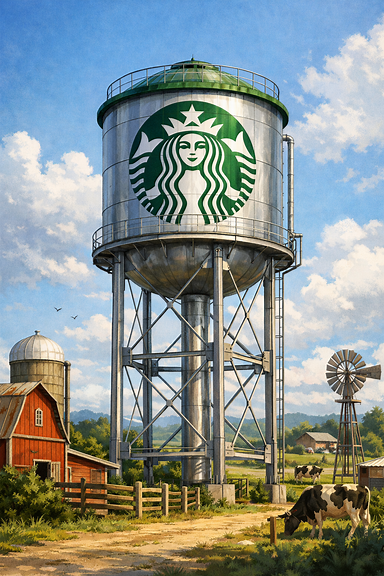
A Society Where a Tank Cannot Be Called a Tank is Not a Healthy Democracy
Written by Ye yearn Cheong Seung-yearn
It was Sunday. My wife and I walked slowly toward a Starbucks near our home. I quietly placed two cups of coffee and a small tumbler on the checkout counter.
It was not a grand gesture. To anyone else, it might have been an ordinary purchase, but to me, it was a small, quiet expression of passive resistance. It was a stand against the fanatic current driven by President Lee Jae-myung and the ruling party, who are attempting to turn the May 18 Democratization Movement into a political religion and a sacred sanctuary, using the Starbucks advertisement controversy as their catalyst.
Lately, the world feels like a roaring, giant wartime arena. Anger is instantly amplified, silence becomes a target of suspicion, and the emotions of the crowd are suddenly absolutized in the name of morality and justice. In particular, the political sentiments surrounding 5·18 seem to be rapidly mutating into a realm of sacrosanct dogma and religious faith.
Yet, paradoxically, the interior of the Starbucks was perfectly serene. Outside the agitated atmosphere manufactured by the media and politicians, this space was still operating within the realm of ordinary "daily life." Young people gathered in small groups were reading books with earphones plugged in, someone was organizing assignments in front of a laptop, and another was gazing out the window, lost in deep thought amidst a long silence.
I stared at that scenery for a long time. Isn't democracy fundamentally meant to protect the freedom of this quiet, daily life? A society where one is not forced to share someone else's anger, where one does not have to prove specific emotions as a badge of loyalty, and where politics does not invade the peaceful, ordinary routine of a citizen enjoying a cup of coffee.
Watching the recent fallout of the Starbucks Korea "Tank Day" crisis under Shinsegae Chairman Chung Yong-jin, many citizens likely felt a profound sense of discomfort and dread going far beyond a mere corporate blunder. A company's careless marketing is entirely open to criticism. The 5·18 Democratization Movement is a tragedy of modern Korean history and a pillar of our democratic heritage; the pain of the victims and bereaved families must naturally be respected.
However, the real issue was the collective reaction that followed. President Lee Jae-myung directly unleashed public fury, cabinet ministers joined in, the ruling party mobilized entirely, and fierce supporters, civic groups, and segments of the media coalesced to create an atmosphere of public lynching. This ultimately culminated in the dismissal of the CEO. Not a few citizens viewed this as a dangerous explosion of mob psychology akin to a political execution, rather than a reasonable critique of a corporate mistake.
Ultimately, one unsettling sentence remained etched in the minds of many citizens:
"Are we truly becoming a society where a tank cannot even be called a tank?"
Of course, the historical wounds of 5·18 must be honored. However, when specific words and images turn into political taboos, and the authority to interpret them is monopolized by a particular faction, society gradually ceases to be a free civil space and degrades into a "political faith community." In a religious political space, ideological loyalty takes precedence over factual context; the slightest mistake is branded as 'blasphemy,' critique is outlawed, and doubt is treated as treason.
President Lee Jae-myung directly lambasted Starbucks three times on his social media account. This went far beyond a standard expression of regret; it was a severe, heavy-handed political edict.
The danger of this method of public targeting is that it operates as a massive political directive. The language of a President carries a weight fundamentally different from that of an ordinary politician. The moment a President publicly singles out a specific private company, his supporters, the bureaucratic apparatus, the ruling party, and civic groups begin to interpret it as an 'operational directive' for action.
In a democratic nation, the sight of a President and cabinet ministers mobilizing a collective apparatus to squeeze a single private enterprise is exceedingly rare and deeply alarming. In a healthy democracy, state power avoids such overt emotional interventions in the private sector because it can wield immense, destructive pressure across tax audits, regulatory hurdles, licensing, financing, and market trust.
It is precisely for this reason that Lee Seok-yeon, the Chairman of the National Integration Committee—highly regarded across both conservative and progressive lines as a veteran legal statesman—recently delivered a direct, stark warning to President Lee Jae-myung regarding deep social divisions and excessive factional polarization. His core thesis was clear: state power must never act as an amplifier of societal rage; it must serve as the final cooling counterbalance to an overheated society.
While studying at the University of Warwick in the UK during the 1980s, I developed a keen interest in the Northern Ireland conflict, which eventually led me to analyze the "Bloody Sunday" incident of 1972. In Derry, Northern Ireland, British paratroopers opened fire on unarmed Catholic civil rights demonstrators, killing 14 people. Because state power deemed citizen resistance a systemic threat and suppressed it with lethal force, it shares a striking structural parallel with 5·18.
The issue, however, was the aftermath. "Bloody Sunday" morphed from a historical tragedy into the core political asset of the Northern Irish nationalist movement. Political forces like Sinn Féin systematically weaponized the incident to cement their narrative of resistance. Commemorative events became spaces for political mobilization, and historical memory began to dictate political fealty. Certain interpretations were strictly enforced, while other expressions became taboo. Dissenting views were instantly vilified as "denying the suffering of the victims."
Consequently, Northern Irish society remained trapped in the vicious cycle of "memory politics" and identity warfare for decades, severely delaying social integration. Even recently, massive political political firestorms erupt simply because related historical footage is utilized in casual social media posts, forcing public apologies. Historical memory remains a hyper-potent, emotionally volatile political currency.
Here, South Korean society must confront a sobering question: Where is 5·18 heading? If 5·18 is utilized as the 'monopolized moral license' of a specific political faction, and specific words or symbols become taboos to test ideological compliance, South Korea will inevitably tumble into the Northern Irish trap of memory politics.
The Starbucks crisis might be the initial symptom. It begins with corporate critique, leads to corporate self-censorship, muzzles the media, and suffocates free academic and cultural discourse regarding historical symbols. Eventually, the focus shifts entirely from the objective truth to a singular, paranoid question: "Have you proven sufficient loyalty to the dogma?"
The Constitution of the Republic of Korea explicitly guarantees freedom of speech, press, and expression. In a democracy, free speech is the final defensive trench protecting a free society. When state power and a political majority create a chilling atmosphere around specific words like "tank," citizens begin to fear social lynching and stigmatization long before legal punishment. They self-censor, free debate withers, and constitutional guarantees are reduced to a hollow shell.
If our society drifts into an atmosphere where a common word like "tank" cannot be uttered freely without fear, it severely erodes the constitutional values of free expression.
Is this truly the image of a healthy democracy? Democracy is fundamentally a system of tolerance—a framework that permits mistakes, dissent, and a plurality of interpretations. History may not repeat itself, but human psychology is chillingly repetitive. And the very first symptom of a dying democracy is the exact moment when ordinary citizens become afraid to speak plain facts as they
A society where a tank cannot be called a tank is not a healthy democracy.
— Written by Ye yearn Cheong Seung-yearn
- 🔗 [[IT Common Sense] Understanding the Brains of Our Computers and Smartphones: CPU, GPU, NPU] (Link)
'Echoes of Thought > Shared Voices' 카테고리의 다른 글
| 카톡으로 받은 '고규영 박사 목 마사지 치매 예방'의 진실! (IBS 네이처 논문 팩트체크) (0) | 2026.05.29 |
|---|---|
| Words Become Flowers (1) | 2026.05.28 |
| 'Tank' is Not a Military Tank, but a 'Water Tank'—An Alias for a Starbucks Tumbler (0) | 2026.05.28 |
| 탱크를 탱크라고 부를 수 없는 사회, 그것은 건강한 민주주의 사회가 아니다. (1) | 2026.05.26 |
| '탱크'는 군용 탱크가 아니라 '물 탱크(water tank)'이고, 스타벅스 텀블러의 별칭 (0) | 2026.05.24 |