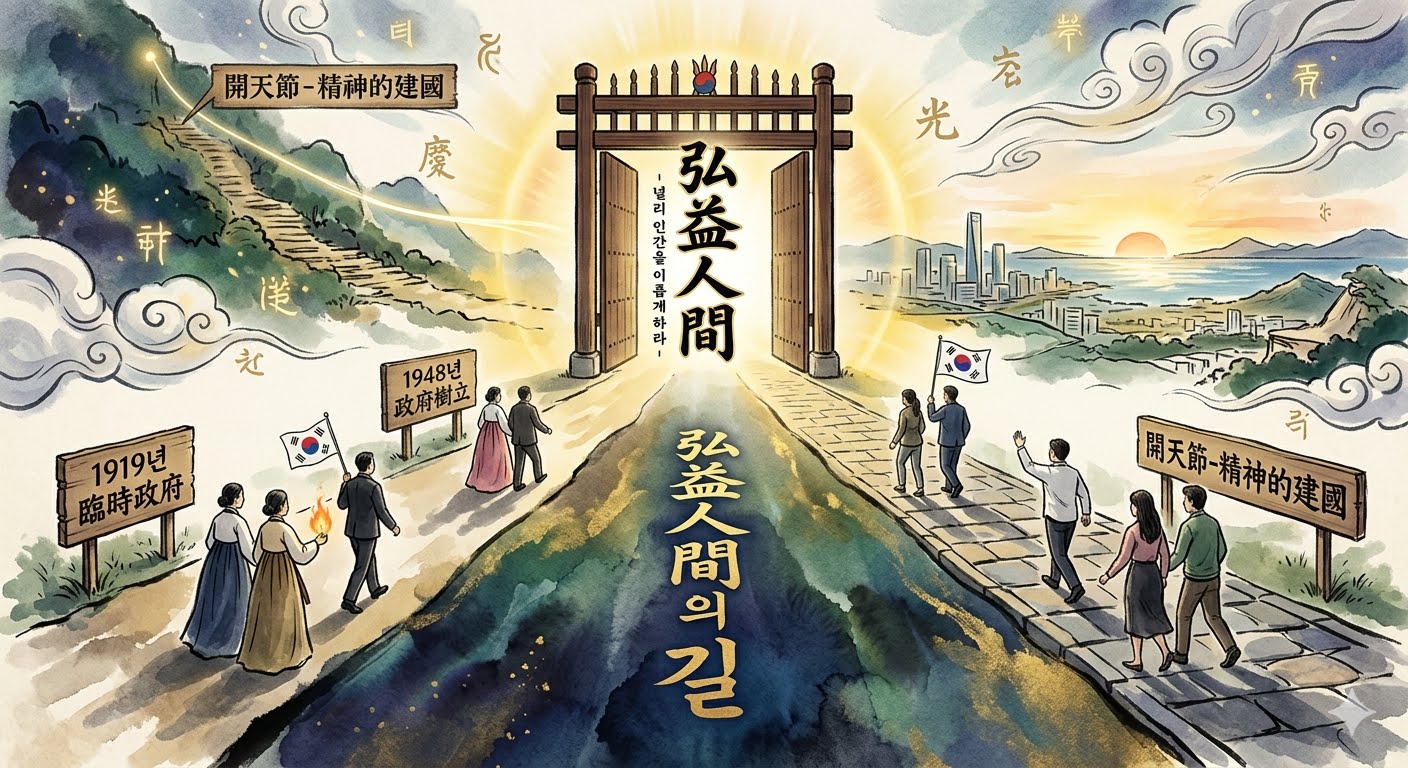
The recurring debate over South Korea’s "Foundation Day" (Geongukjeol) inevitably spirals into a counterproductive political dispute every year. Arguments split deep along ideological lines over whether to regard the establishment of the Provisional Government in 1919 as the nation's true beginning, or the official formation of the Republic of Korea government in 1948. However, this issue must transcend a mere political scramble to claim a specific date. It should instead lead us to a fundamental question: How do we view our national identity and historical roots? The crucial missing link that answers this question is the spirit of 'Hongik Ingan' (弘益人間).
'Hongik Ingan' is the founding philosophy of Gojoseon, the first Korean kingdom, and it carries the sublime meaning of "broadly benefiting all of humanity." This principle served as the core justification for the state's existence within the Dangun myth. Surviving through the ages, it remains explicitly enshrined in the preamble of the current Constitution of the Republic of Korea. Therefore, when discussing Foundation Day, the primary focus should not be on pinpointing a specific date of an institutional event, but on the much more vital essence: the foundational spirit upon which this nation was built.
When viewed through this lens, the puzzle of our history finally falls into place. Gaecheonjeol (National Foundation Day) commemorates the day Dangun established Gojoseon, serving as a declaration that the spirit of 'Hongik Ingan' is the eternal starting point of our people and state. Conversely, the establishment of the Provisional Government in 1919 and the formation of the Republic of Korea government in 1948 were the institutional and political "alternative paths" (or lanes) carved out amidst the fierce challenges of their respective eras to manifest that very spirit.
Ultimately, the Foundation Day debate is nothing more than an attempt to separate the different historical routes taken to reach the same destination. While Gaecheonjeol symbolizes our 'spiritual foundation,' the Provisional Government represents the 'legitimacy of the independence movement,' and the 1948 government signifies our 'institutional departure' as a modern state. What matters most is that these paths do not collide; they run parallel toward a single, shared destination: the realization of the 'Hongik Ingan' spirit.
Therefore, Foundation Day must not be treated as a backward-looking question of “when was the nation established?” Instead, it must be a forward-looking inquiry: “With what spirit did we build this nation, and where are we heading next?” 'Hongik Ingan' already provides that magnificent answer. Foundation Day is a day to commemorate and inherit this grand philosophy—serving as both the identity of the Republic of Korea and its perfect milestone for the future
건국절 논쟁의 해법, '홍익인간'이라는 목적지
매년 반복되는 대한민국의 건국절 논쟁은 소모적인 날짜 싸움으로 치닫곤 한다. 1919년 임시정부 수립일을 국가의 시작으로 볼 것인가, 아니면 1948년 대한민국 정부 수립일을 건국으로 볼 것인가를 두고 진영 간의 골은 깊어져만 간다. 그러나 이는 단순히 특정 날짜를 선점하려는 정치적 계산을 넘어, 국가의 정체성과 뿌리를 어떻게 바라볼 것인가라는 본질적인 질문으로 이어져야 한다. 이때 우리가 주목해야 할 결정적 연결고리가 바로 '홍익인간(弘益人間)' 정신이다.
홍익인간은 고조선의 건국이념으로 “널리 인간을 이롭게 하라”는 숭고한 뜻을 담고 있다. 이는 단군신화 속에서 국가의 존재 이유를 설명하는 핵심 원리였으며, 시대를 관통하여 오늘날 대한민국 헌법 전문에도 엄연히 명시되어 있다. 따라서 건국절을 논할 때, 제도적 사건의 날짜를 정하는 것보다 훨씬 더 중요한 본질은 '과연 이 국가가 어떤 정신을 바탕으로 세워졌는가'라는 점이다.
이러한 관점에서 바라보면 역사의 퍼즐이 비로소 제자리를 찾는다. 개천절은 단군이 고조선을 세운 날을 기념하는 국경일로, 홍익인간 정신을 우리 민족과 국가의 영원한 출발점으로 삼았음을 선언한 날이다. 반면 1919년의 임시정부 수립이나 1948년의 대한민국 정부 수립은 그 정신을 담아내기 위해 시대적 상황 속에서 치열하게 모색한 제도적·정치적 '차선(車線)'들이다.
결국 건국절 논쟁은 목적지에 도달하기 위한 서로 다른 역사적 경로(차선)를 구분하는 일에 불과하다. 개천절이 '정신적 건국'을 상징한다면, 임시정부는 '독립운동의 대표성'을, 1948년 정부 수립은 현대 국가로서의 '제도적 출발'을 상징할 뿐이다. 중요한 것은 이 모든 차선이 결코 서로 충돌하는 길이 아니며, 결국 '홍익인간 정신의 실현'이라는 하나의 공동 목적지를 향해 평행하게 달리고 있다는 사실이다.
따라서 건국절은 단순히 “언제 나라가 세워졌는가”라는 과거의 질문이 아니라, “우리가 어떤 정신으로 나라를 세웠고 어디로 나아갈 것인가”라는 미래지향적 질문으로 귀결되어야 한다. 홍익인간은 이미 그 위대한 답을 제공하고 있다. 건국절은 곧 홍익인간 정신을 기념하고 계승하는 날이며, 대한민국의 정체성과 미래를 향한 가장 완벽한 이정표다.
더보기
Epic Korean traditional orchestral cantata, majestic Catholic oratorio style, powerful mixed grand choir, driving brass, traditional percussion, Buk, Jing, Haegeum, cinematic, glorious, fast and heavy temp
(해석: 에픽 한국 전통 오케스트라 칸타타, 장엄한 가톨릭 오라토리오 스타일, 강력한 혼성 대합창, 질주하는 금관악기, 전통 타악기 북과 징, 해금, 영화 같은 영광스럽고 빠르며 웅장한 템포)
[Intro]
(Powerful traditional drums 'Buk' and 'Jing' booming, orchestra building up grandly)
[Verse 1]
(Majestic Male Choir, deep and resonant)
언제 나라가 세워졌나 날짜를 묻지 마라
어떤 정신으로 세웠는가 본질을 바라보라
눈앞의 갈등과 논쟁을 넘어 (넘어!)
우리 민족 거대한 뿌리를 보라
[Verse 2]
(Bright Female Choir, rising up)
개천절의 새벽 하늘 정신적 건국이요
임시정부 독립정신 뼈대를 세웠도다
대한민국 정부수립 제도적 출발이니
모든 역사의 차선은 하나로 흐른다
[Chorus]
(Explosive Full Choir, high energy, glorious)
홍익인간! 널리 인간을 이롭게 하라!
대한민국의 영원한 정체성이여!
과거를 지나 미래로 달리는 위대한 이름
홍익인간 정신으로 나라를 세웠도다!
[Bridge]
(Orchestra Climax, brass and Haegeum soaring)
서로 다른 길을 걸어도 목적지는 오직 하나
이 땅에 평화와 번영을 꽃피운 역사 앞에
대한민국 찬란한 빛을 발하라! 영원하라!
[Chorus]
(Explosive Full Choir, maximum energy)
홍익인간! 널리 인간을 이롭게 하라!
대한민국의 영원한 정체성이여!
과거를 지나 미래로 달리는 위대한 이름
홍익인간 정신으로 나라를 세웠도다!
[Outro]
(Slowing down, massive and heavy orchestral finish)
대한민국 영원하리라.
[Spoken]
(Solemn and deep voice)
"예연 정승연."
[Journey of Reflection : 지나온 사색의 여정]
광복절인가? 건국절인가?